


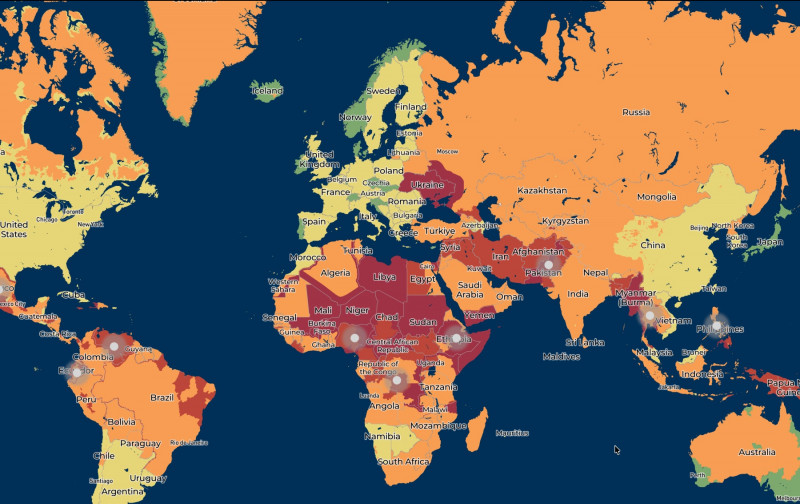
What the 2027 Global Risk Map Means for International Buyers
Global Guardian’s 2027 Global Risk Map classifies Croatia within its Low Risk category. The assessment considers a broad range of factors, including crime, conflict, healthcare, natural disasters, infrastructure, political stability, civil unrest and terrorism. Global Guardian’s 2027 edition also looks more closely at differences within countries, recognising that risk is not always uniform across an entire territory.
For international property buyers, this adds another dimension to Croatia’s appeal as a place to live, own a second home or hold property for the long term.
What does the 2027 Global Risk Map say about Croatia?
Global Guardian is a U.S. based international duty of care and security provider serving global organisations, Fortune 1000 companies, high-net-worth individuals and private clients. Its annual Global Risk Map evaluates security conditions around the world using factors including crime, conflict, health, natural disasters, infrastructure, political stability, civil unrest and terrorism.
On the 2027 map, Croatia is shown in green and classified within the Low Risk category. It shares this low-risk positioning with a number of highly stable European countries, including Switzerland, Norway, Denmark Portugal, Luxembourg and Ireland.
For people who live in Croatia, everyday safety can easily be taken for granted. For someone considering where to relocate, spend several months each year or purchase a second home abroad, it can be an important part of the decision.
Why does safety matter to property buyers?
International buyers naturally consider property prices, accessibility, lifestyle, taxation, quality and potential long-term value. But a property does not exist in isolation. The stability of the country around it, quality of infrastructure, personal safety and reliability of institutions all influence how comfortable people feel owning property and spending time there.
Can you comfortably bring your family? Can you imagine spending several months of the year there? Could it eventually become a permanent home? Do you feel confident holding part of your wealth there for the long term? These questions matter.
Croatia’s position on the Global Guardian map does not mean that every Croatian property is automatically a good investment, nor does the report measure future real estate returns. What it does provide is an independent perspective on the wider environment in which people choose to live and own property.
The security premium
For decades, much of global business was optimised around efficiency and the lowest possible cost. That equation is changing.
Geopolitical instability and repeated disruptions have made businesses increasingly willing to pay for resilient supply chains, redundancy and reliable jurisdictions. Global Guardian itself notes that companies can face disruption to supply chains, market access and infrastructure even when they have no direct presence in a conflict zone.
I believe a similar shift will increasingly influence real estate decisions. The cheapest location is not necessarily the best location in which to establish a second home, build a long-term base or hold an important part of your wealth.
In a more uncertain world, stability, personal safety, infrastructure and institutional reliability may increasingly be worth a premium. This is what we call the security premium.
Croatia’s position
Croatia combines several qualities that are increasingly relevant to international buyers: everyday safety and stability, EU and eurozone membership, established infrastructure, accessibility from the rest of Europe and a Mediterranean lifestyle centred around the Adriatic. For different buyers, that combination can mean different things. It may be a permanent home, a second residence, a long-term property investment or a European base to which they can return throughout the year.
For members of the Croatian diaspora considering a return home, the same qualities can form part of an even bigger decision about where to build the next stage of their lives. From Zagreb to Istria, Kvarner and Dalmatia, the individual property and micro-location will always remain important. Price, legal status, quality, future supply and local demand still need to be carefully evaluated. But I believe the stability of the country itself deserves a place in that equation.
Sometimes the value of a place is not only what you can buy there, but how you can live there.
Author: Ivan Varat
Founder & CEO, San Patrik Real Estate
International property advisory in Croatia
Member of Leading Real Estate Companies of the World®


