


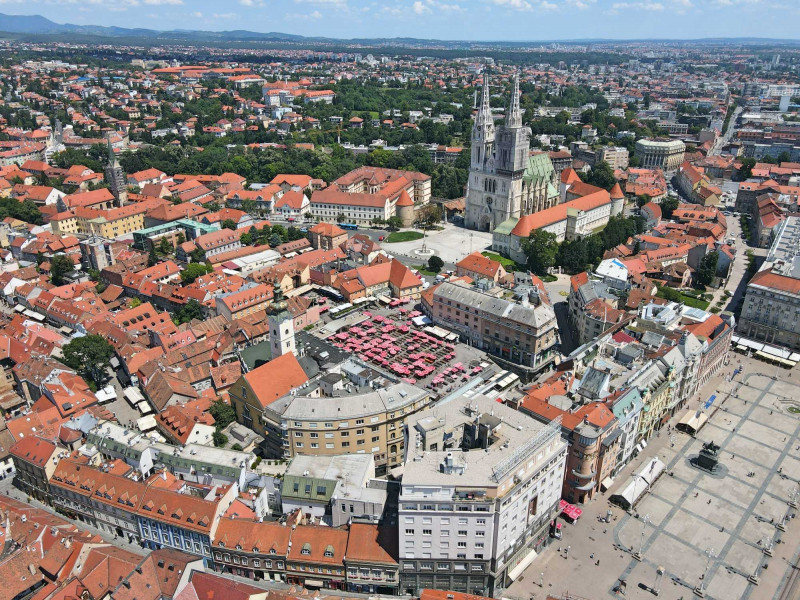
Although 2020 was a year full of challenges, with ups and downs, the fact remains that the Zagreb real estate market exceeded experts’ expectations. Demand for property, and consequently prices per square meter, have been rising since 2015. Records were broken in 2019, while the challenging year of 2020 indicated the trends that are likely to follow.
With all of this in mind, one big question remains: will the real estate market in 2021 continue its upward trajectory, or are we facing a possible downturn?
In this article, we take a deeper look and project market movements for 2021 in order to provide you with relevant data needed for making successful decisions in the current year.
Same or lower interest rates in 2021
One of the main drivers of the market boom has been record-low mortgage interest rates, ranging from 2.5% to 3%. Government-subsidized housing loans for young families through the APN program have pushed interest rates even closer to 2%.
A few years ago, the cost of money was artificially lowered by the European Central Bank’s policy. The goal was to keep economic activity moving. People were encouraged to invest, spend, and launch new projects instead of saving. This policy remains in place, so we can expect similar interest rates going forward, and likely a slight decrease. Over the next year, rates could drop by another 0.2% to 0.3%. There is room for that, as capital remains inexpensive while demand for loans has slightly decreased. Interest rates could therefore range between 2.2% and 2.7%, according to Pro grupa.
Another positive development for Croatia’s demographics and the stability of demand in the housing market came at the end of 2020. The Ministry of Construction announced that APN subsidies for young families will continue until 31 December 2023.
Although average real estate prices in Zagreb, especially for new developments, have been rising since 2015, low interest rates and APN subsidies have made purchases more accessible. This trend is expected to continue into 2021.
Impact of GDP on the real estate market
The development of the real estate and construction sectors is important for the national economy and people’s lives and represents a key macroeconomic indicator. The total value of real estate transactions in Croatia in 2019 amounted to HRK 39.8 billion, representing 10% of the country’s GDP that year. By property type, apartments accounted for 41.9% of the total value of transactions, followed by building land at 21.1% and family houses at 19%.
According to the World Bank, Croatia’s GDP fell by 8.6% in 2020 compared to the previous year. However, the forecast for 2021 is economic growth of 5.4%, driven primarily by vaccination against COVID-19 and new investments.
Analytics show that the real estate market curve is proportionally linked to GDP trends, though with some delay. The GDP drop in 2020, caused by the pandemic and economic shutdowns, affected the real estate market in terms of reduced demand and fewer transactions. However, property prices in Zagreb did not fall significantly, partly due to the earthquakes, which increased demand and attractiveness for new construction.
Demand for newer earthquake-resistant properties with reinforced concrete construction capable of withstanding magnitude 8 on the Richter scale remains high. These properties are likely to maintain their prices. On the other hand, there is a realistic possibility of price declines for older and lower-quality properties that do not meet seismic standards.
Some industries in Croatia remain closed, and the government continues to provide support to preserve jobs. According to the Croatian Employment Service, the unemployment rate was 6.3% in the first quarter, 6.5% in the second quarter, and 9.3% in November 2020, with growth in average nominal gross wages slowing.
If a negative scenario occurs in which the economy does not grow in 2021 as predicted and unemployment rises further, a more significant decline in property prices, including new developments, is possible.
The earthquake and reconstruction of Zagreb
In March 2020, Zagreb was hit by a strong earthquake measuring 5.5 on the Richter scale, bringing major changes to the real estate market. Another devastating earthquake at the end of December 2020, measuring 6.2 with an epicenter near Petrinja, was strongly felt in Zagreb and further influenced buyers’ decisions.
The March earthquake caused the most material damage in central Zagreb, where older buildings (80+ years old) were most affected, as well as in parts of the eastern foothills of Mount Medvednica, near the epicenter, where older family houses and, in some cases, poorly constructed newer buildings were damaged.
Before the earthquake, the city center was one of the most attractive locations in Zagreb, with prices rising faster than in other neighborhoods. After the earthquake, prices in the center generally did not fall significantly, mainly because transactions practically stopped. Buyers felt uncertain, tourism was halted due to the pandemic, the short-term rental market declined sharply, and the city center is currently, and will continue to be, a major construction site. At the same time, property owners are waiting for the reconstruction process, which is expected to be largely financed by EU funds.
Although the Reconstruction Act for earthquake-damaged buildings was adopted and the Reconstruction Fund for the City of Zagreb and surrounding counties was established, it is still unclear how implementation will look in practice and when reconstruction will begin (May 2021 was mentioned at the time). Only after full reconstruction and the return of tourism could demand and prices in the city center return to 2019 levels.
As mentioned earlier, the earthquake increased demand for newer earthquake-resistant properties with reinforced concrete structures, particularly in districts such as Trešnjevka North and Trešnjevka South and other areas well connected by public transport, especially tram lines.
The reconstruction of Zagreb and the Banovina region after the earthquakes carries positive expectations for growth in real estate activity and the construction sector overall. In addition to direct effects on activity, this will stimulate growth in related sectors and provide further momentum for economic activity and GDP growth in 2021 and the years ahead.
Trends in 2021
The pandemic and lockdowns, during which people spent more than a month confined to their homes, along with the earthquakes, further influenced changing buyer preferences. These trends are expected to continue in 2021.
Buyers are increasingly turning toward building land, houses with larger gardens on the outskirts and around Zagreb, and apartments with gardens or larger terraces.
Changes in business operations and the rise of working from home have also created new trends, including increased demand for additional workspace within residential properties.


